Rihito SakuraiQuantum computing & tensor networks

Research memories

Figures, small discoveries, and things I remember.

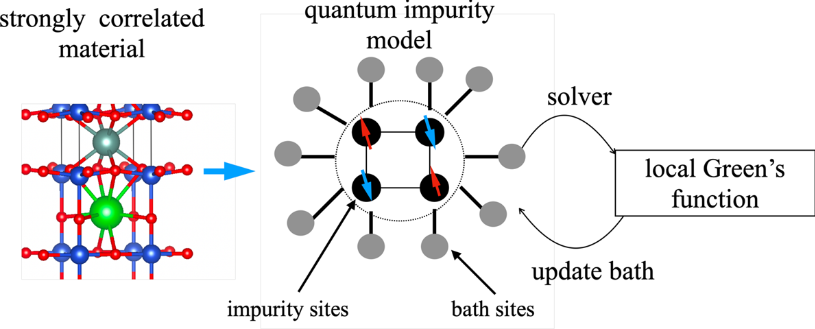
A strongly correlated material is mapped to impurity sites coupled to bath sites. A solver computes the local Green’s function, which is used to update the bath in a self-consistency loop.
A quantum impurity model and the DMFT self-consistency loop. Click the figure to enlarge it.

2022

My first paper!

This picture connects a strongly correlated material to a small quantum impurity model and its surrounding bath. In this work, we explored a hybrid quantum–classical approach to computing the impurity model’s imaginary-time Green’s function.

R. Sakurai, W. Mizukami, and H. Shinaoka,
Hybrid quantum-classical algorithm for computing imaginary-time correlation functions.
Phys. Rev. Research 4, 023219 (2022). Figure: CC BY 4.0.
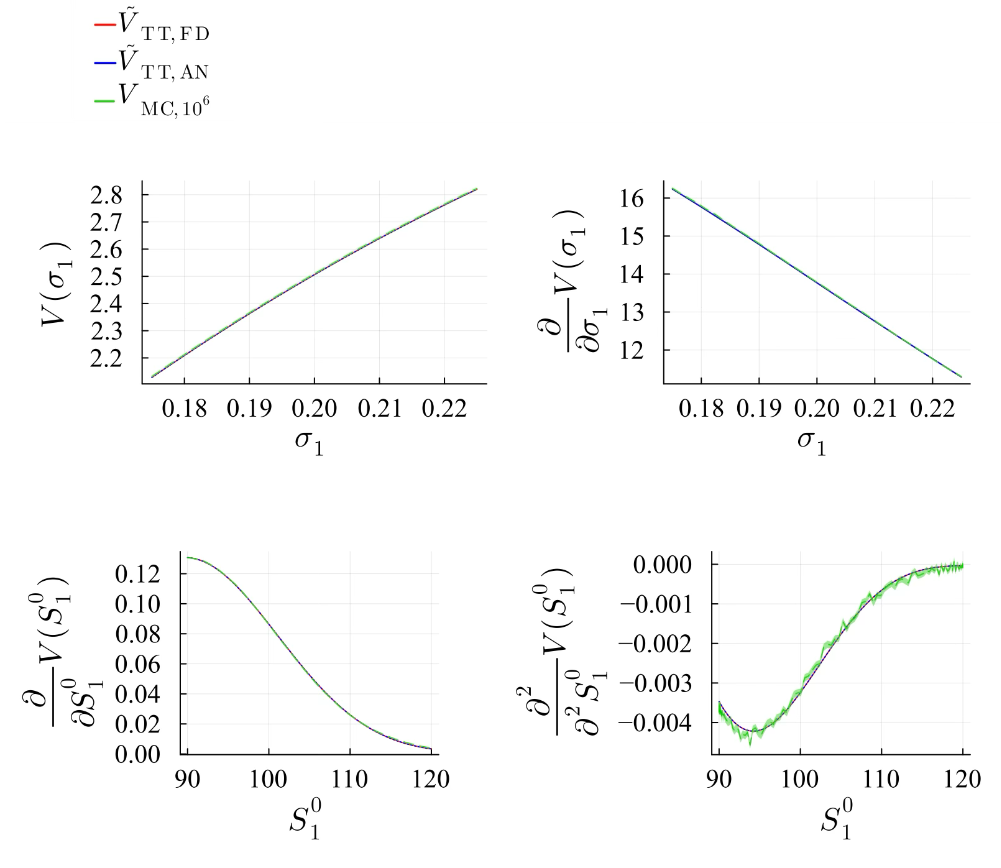
Four plots compare tensor-train methods in red and blue with Monte Carlo in green: option price and Vega versus volatility, and Delta and Gamma versus the initial asset price. The curves closely overlap, with visible Monte Carlo fluctuations in Gamma.
Price, Vega, Delta, and Gamma for a five-asset min-call option with random correlations. Red and blue: tensor trains; green: Monte Carlo. Click the figure to enlarge it.

2025

Prices and Greeks with tensor trains

Here we used tensor trains to compress Fourier-based option pricing and compute its sensitivities, the Greeks. The figure compares two tensor-train approaches with Monte Carlo: the curves track one another closely in these slices.

R. Sakurai, K. Miyamoto, and T. Okubo,
Tensor train representations of Greeks for Fourier-based option pricing of multi-asset options.
arXiv:2507.08482v1 (2025). Figure: CC BY 4.0.

CC BY-SA 4.0 Rihito Sakurai. Last modified: October 03, 2026. Website built with Franklin.jl and the Julia programming language.